
AI vs Humans: Who Will Win the Future of Work?
The debate around AI vs humans who will win the future of work ? has moved far beyond science fiction. Artificial intelligence is already changing how businesses operate, how employees complete tasks, and how customers interact with companies. From writing and design to data analysis, customer service, manufacturing, and software development, AI is becoming part of everyday work.
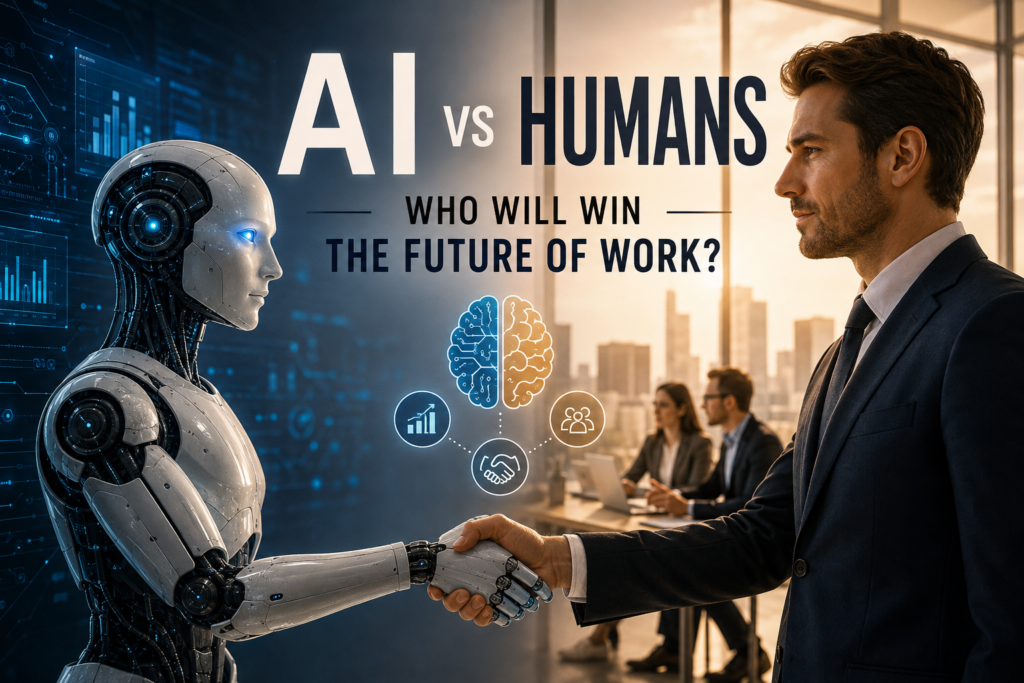
But this raises a major question: Will AI replace humans, or will humans remain at the center of the future workplace?
The answer is more complicated than choosing one side.
AI is exceptionally good at processing large amounts of information, identifying patterns, automating repetitive tasks, and generating content quickly. Humans, on the other hand, bring creativity, emotional intelligence, judgment, empathy, leadership, ethics, adaptability, and real-world experience.
So, when we look at AI vs humans, the future of work may not be about one defeating the other. Instead, the biggest opportunity may come from humans and AI working together.
The Rise of AI in the Workplace
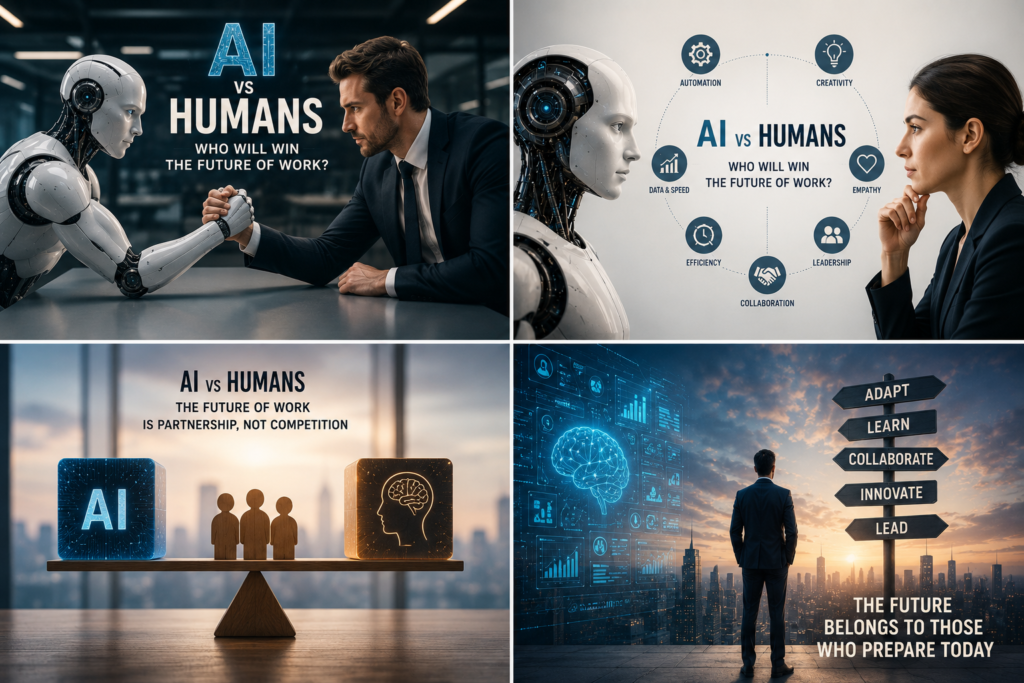
Artificial intelligence has developed rapidly. Businesses are adopting AI tools to improve productivity, reduce repetitive work, analyze information, personalize customer experiences, and support decision-making.
For employees, AI can act like a powerful assistant. It can help summarize documents, analyze data, generate ideas, automate routine processes, and provide first drafts of content or reports.
This does not necessarily mean that every AI-assisted workplace will need fewer employees. In many cases, it means that employees can spend less time on repetitive tasks and more time on higher-value activities.
For example, a marketing professional may use AI to generate initial campaign ideas, but the human still needs to understand the customer, define the brand strategy, evaluate the ideas, and make the final decisions.
This distinction is essential when discussing AI vs humans .
AI can automate tasks, but a job is usually made up of many different tasks.
AI vs humans – Will AI Replace Human Jobs?
One of the biggest fears surrounding the future of work is mass job replacement.
Some occupations will undoubtedly change because of automation. Jobs involving highly repetitive, predictable, and rule-based tasks are generally more exposed to AI-driven automation.
However, saying that AI will simply replace all human workers oversimplifies the situation.
A job often involves communication, collaboration, problem-solving, judgment, relationship-building, and responsibility. These areas are much harder to automate completely.
Consider a manager. AI may help analyze employee performance data or prepare reports, but leadership involves motivating people, resolving conflicts, understanding personalities, building trust, and making difficult decisions.
Similarly, AI can assist a doctor by processing information, but healthcare also requires empathy, communication, ethical judgment, and an understanding of the individual patient.
The real transformation may therefore be less about humans versus machines and more about humans using machines effectively.
Where AI Has the Advantage
To understand the future of work, we need to recognize where AI performs better than humans.
1. Speed
AI can process information and produce outputs extremely quickly. A task that might take a human several hours can sometimes be completed or accelerated by an AI system in minutes.
2. Data Processing
Humans have limited capacity for analyzing massive datasets. AI systems can identify patterns across huge volumes of information and help businesses make data-driven decisions.
3. Repetitive Tasks
AI is particularly valuable when work is repetitive and predictable. Automating these tasks can save time and allow employees to focus on more meaningful responsibilities.
4. Consistency
AI can perform standardized processes consistently without getting tired or distracted in the same way humans can.
5. Availability
AI systems can operate continuously, making them useful for certain customer service, monitoring, analysis, and operational tasks.
These advantages explain why AI automation will continue to play an important role in the workplace.
Where Humans Still Have the Advantage
Despite the remarkable capabilities of artificial intelligence, humans possess qualities that remain extremely valuable.
1. Creativity
AI can generate ideas by learning from patterns and existing information, but humans provide personal experiences, cultural understanding, intuition, and original perspectives.
The strongest creative work may increasingly come from people who know how to use AI as a creative partner rather than treating it as a replacement for human thinking.
2. Emotional Intelligence
Understanding emotions is fundamental to leadership, sales, negotiation, teamwork, teaching, healthcare, and customer relationships.
Human beings can recognize subtle emotional signals and respond to complex interpersonal situations.
3. Empathy
A machine can generate an empathetic-sounding response, but human relationships are built through genuine connection, shared experiences, trust, and understanding.
4. Critical Thinking
AI can provide information and recommendations, but humans must evaluate whether those recommendations make sense.
The ability to question information, recognize risks, understand context, and make responsible decisions will become increasingly important.
5. Leadership
Leadership is not simply about making decisions. It involves inspiring people, communicating a vision, handling uncertainty, managing conflict, and taking responsibility.
These human skills will remain essential in the future workforce.
The Most Valuable Skill May Be Working With AI
The question may not be whether someone can compete against AI.
A better question is:
Can someone who uses AI effectively outperform someone who does not?
This is where the concept of human-AI collaboration becomes important.
A professional who understands both their field and AI may be able to work faster and produce better results than someone who relies entirely on traditional methods.
For example, a designer can use AI to explore concepts rapidly while applying human judgment to choose the strongest direction. A salesperson can use AI to organize customer information while using human communication skills to build relationships. A writer can use AI for research organization and brainstorming while maintaining their own voice, perspective, and editorial judgment.
The competitive advantage may therefore belong to people who combine human expertise with AI skills.
AI vs humans – The Future of Work Will Reward Adaptability
Technology has always changed the workplace.
Previous generations experienced the arrival of computers, the internet, smartphones, cloud computing, and automation. Each transformation eliminated some tasks while creating new roles and changing existing ones.
AI is another major shift.
The difference is that AI can influence knowledge-based work as well as physical and repetitive tasks.
This means adaptability will become one of the most important skills for professionals.
Workers who continuously learn, experiment with new tools, and understand how technology affects their industries will be better positioned for change
AI vs humans – Which Jobs Are Most Likely to Change?
Almost every industry could experience some level of AI-driven transformation.
Administrative work may become more automated. Customer service teams may use AI assistants. Marketing departments may rely on AI for research and content development. Financial professionals may use AI for analysis. Software developers may use AI coding assistants. Designers may use generative tools for ideation.
But transformation does not automatically mean elimination.
Many roles could evolve into hybrid positions where employees supervise, direct, evaluate, and improve AI-generated work.
This could create a new category of professionals who are neither traditional workers nor AI engineers but AI-enabled professionals.
For businesses, this means workforce development will become increasingly important.
AI vs humans – Human Skills Will Become More Valuable
As AI becomes better at technical and repetitive tasks, distinctly human skills could become even more valuable.
Important skills for the jobs of the future may include:
- Creativity
- Communication
- Leadership
- Emotional intelligence
- Critical thinking
- Problem-solving
- Collaboration
- Adaptability
- Strategic thinking
- Ethical decision-making
- Relationship building
- Industry expertise
Interestingly, many of these skills are difficult to measure with traditional qualifications.
A future employer may care not only about what a candidate knows but also about how effectively that person can work alongside intelligent technology.
AI vs humans – AI Cannot Replace Human Responsibility
There is another important issue in the AI vs humans debate: accountability.
When an AI system produces an incorrect recommendation, biased result, misleading statement, or poor decision, organizations still need humans who can evaluate the outcome and take responsibility.
This makes human oversight particularly important in sensitive areas such as healthcare, finance, law, education, hiring, and public services.
AI can support decisions, but organizations need people who understand the consequences of those decisions.
The future workplace will therefore require not only technical AI knowledge but also responsible AI use.
AI vs humans – The Winning Model: Humans + AI
Instead of imagining the future as a competition between humans and machines, imagine a partnership.
AI provides:
Speed + Scale + Automation + Data Processing + Pattern Recognition
Humans provide:
Creativity + Judgment + Empathy + Leadership + Context + Responsibility
Together, these capabilities can create a much more powerful workplace.
A business that uses AI without human oversight may become efficient but make poor decisions. A business that ignores AI may struggle to compete with organizations that embrace technology.
The strongest model is likely to combine both.
How Professionals Can Prepare for the Future – AI vs humans
The best response to workplace automation is not panic. It is preparation.
Learn AI Fundamentals
You do not necessarily need to become a programmer. Understanding what AI can do, where it performs well, and where it can fail is becoming useful across many professions.
Develop Your Human Advantage
Strengthen skills that technology struggles to replicate, including communication, creativity, leadership, negotiation, empathy, and critical thinking.
Learn to Prompt and Collaborate
Knowing how to communicate effectively with AI systems can improve productivity. Clear instructions, context, evaluation, and refinement are increasingly valuable skills.
Become an Industry Expert
AI tools are widely available. Deep industry knowledge is harder to replace.
Someone who understands both their industry and AI can often create significantly more value than someone who understands only the technology.
Keep Learning
The workplace will continue to evolve. Continuous learning may become more important than relying on a single qualification or skill set throughout an entire career.
So, Who Will Win: AI vs humans?
The answer to AI vs humans is surprisingly simple:
Neither will truly win alone.
The biggest winners in the future of work are likely to be the people and organizations that understand how to combine artificial intelligence with human capabilities.
AI will continue to automate tasks, accelerate workflows, analyze information, and support decision-making. Humans will continue to provide purpose, creativity, judgment, empathy, leadership, and accountability.
The future is unlikely to be a workplace where humans disappear and machines take over everything.
Instead, it may be a workplace where the definition of a productive employee changes.
The most valuable professional may not be the person who can do everything manually. It may be the person who knows what should be done by AI, what should be done by humans, and how to bring the two together effectively.
Final Thoughts – AI vs humans
The future of work will not be determined by technology alone. It will be shaped by how businesses, employees, educators, and society respond to technological change.
AI is powerful, but human intelligence has qualities that cannot simply be reduced to speed or computation.
The real opportunity lies in collaboration.
Rather than asking whether AI will replace humans, we should ask how humans can use AI to become more creative, productive, strategic, and capable.
The future may not belong to AI instead of humans.
It may belong to humans who know how to work with AI.